MotiveCrate Guides
Windshield Washer Hose Kit: Universal 5-Piece Installation Guide
Windshield Washer Hose Kit: Universal 5-Piece Installation Guide - Universal washer hose kit installation: how to identify a failing hose, route a replacement, use T and Y connectors, and avoid the two mistakes that cause leaks. | MotiveCrate
September 21, 2026 · 4 min read · By MotiveCrate
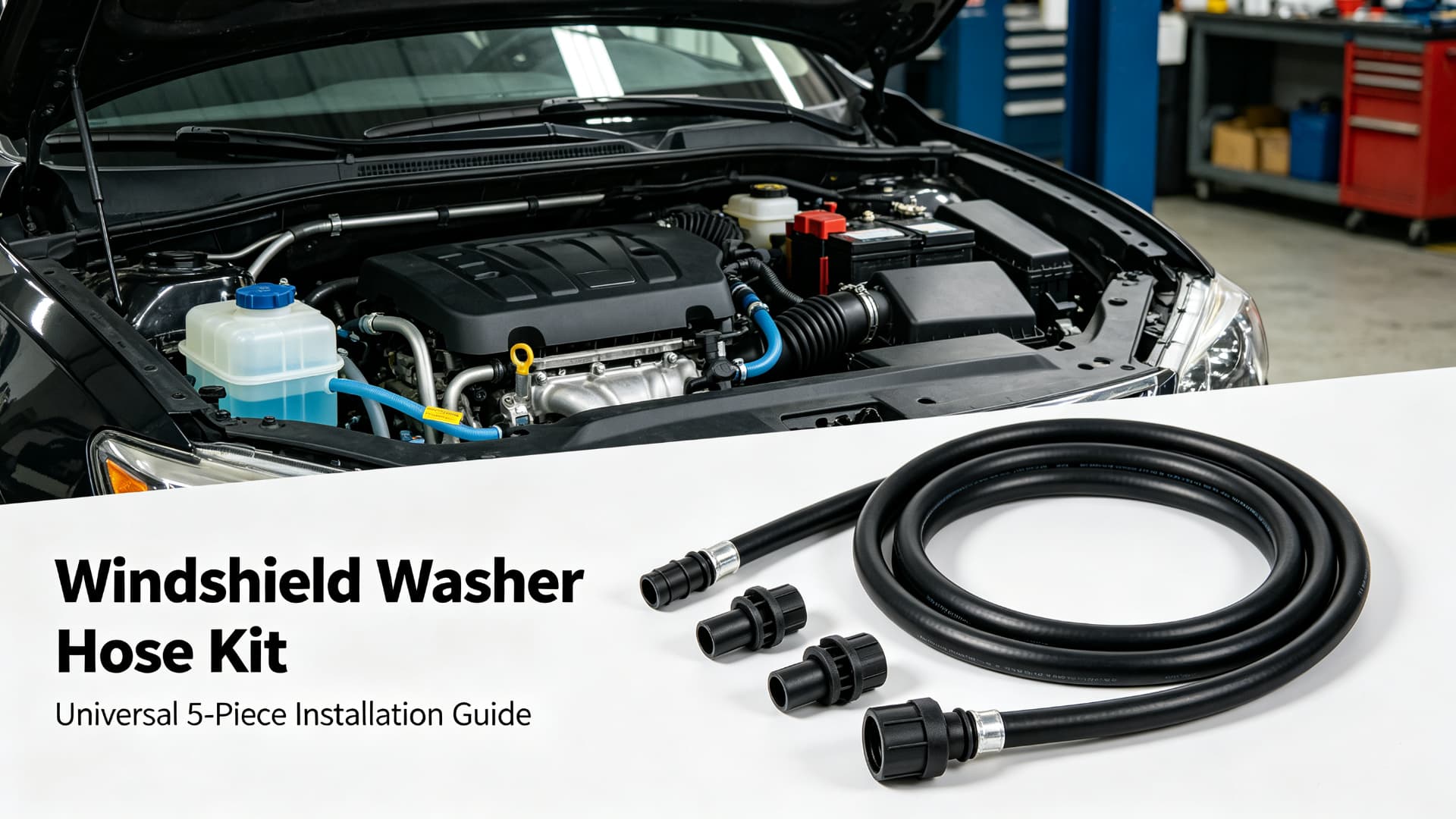
Most washer problems that are not the nozzle are the hose. Washer hose is thin rubber or PVC that hardens, cracks and kinks with age — and it is usually the cheapest part in the system to replace. A universal kit with 2 m of hose plus T and Y connectors covers most single-vehicle repairs. This guide shows how to identify a bad hose, route a replacement, and avoid the two mistakes that cause leaks.
Signs your washer hose needs replacing
| Symptom | What it indicates |
|---|---|
| Spray only from one nozzle | Hose kinked, disconnected, or split on that branch |
| Wet patch under the hood after use | Split hose leaking before the nozzle |
| Spray weakens as the engine bay warms | Hose softening and collapsing |
| Visible cracks at bends or near clamps | Rubber has hardened — will fail soon |
| Dark specks at the nozzle inlet | Hose degrading from the inside |
| Pump runs but nothing reaches the glass | Disconnected or blocked hose |
A hose that "looks fine" can still leak. Cracks often start at the sharpest bend or right behind a clamp where you cannot see them.
What the universal kit covers
| Component | Purpose |
|---|---|
| 2 m flexible hose | Main run plus branches for most vehicles |
| T connector | Splits one line into two — the common twin-nozzle layout |
| Y connector | Splits at an angle where a T would kink the hose |
| Assorted fittings | Adapters for common nozzle and pump barb sizes |
2 m is enough for most cars. Measure your existing run first if the routing is unusually long, and remember you need extra length for the split to the second nozzle.
Before you start
- Note the routing. Photograph the hose path before removing anything — routing around hinges and clips matters.
- Check the nozzle and valve first. If the spray is delayed rather than absent, the fault is the check valve, not the hose.
- Work warm. Cold hose cracks when you bend it. If it is below freezing, let the engine bay warm up first or wait.
Installation
Tools: scissors or sharp knife, small screwdriver, replacement hose and connectors.
- Disconnect the old hose at the reservoir/pump end and at each nozzle.
- Remove the old hose from its clips and routing. Keep the clips — you will reuse them.
- Cut the new hose to length, allowing 5–10 cm extra at each end for fitting and movement.
- Cut cleanly at 90°. A ragged or angled cut will not seal and will weep.
- Push the hose onto the barb until it fully seats. Warm the hose end in your hand first if it is stiff.
- Fit the T or Y connector where the line splits to the second nozzle, matching the original layout.
- Re-route through the original clips. Keep the hose away from hot or moving parts.
- Test with the hood open and watch for weeps at every joint.
- If a joint weeps, do not add sealant. Re-cut the hose squarely and refit — sealant contaminates the system and clogs nozzles.
The two mistakes that cause leaks
1. Cutting the hose at an angle. The barb cannot seal against an angled cut, and the leak shows up only under pump pressure. Always cut square.
2. Routing the hose against a hinge or hot surface. The hose rubs through within months. Follow the factory routing and reuse the clips.
Never use compressed air to clear a blockage while the system is assembled. It can blow a joint apart inside the fender, turning a small job into a liner-removal job.
While you are in there
- Nozzles — inspect for scale. See 7 causes of clogged nozzles.
- Check valve — a cheap part to replace while the line is open.
- Reservoir cap — a cracked cap is what feeds debris into the hose in the first place.
Frequently asked questions
How much washer hose do I need?
Most vehicles need 1.5–2 m including the branch to the second nozzle. A 2 m universal kit covers most single-vehicle jobs. Measure your existing run if the routing is unusually long.
Can I use any hose for a washer system?
Use hose rated for water and mild washer fluid — not fuel or vacuum line, which can degrade or contaminate the fluid. The kit hose is formulated for washer systems.
Why does my washer only spray on one side?
A kinked, disconnected or split hose on that branch is the usual cause. Follow the line from the working nozzle to the split point and inspect the branch to the dead nozzle.
Do I need a T or a Y connector?
A T splits the flow at a right angle; a Y splits it at a gentler angle that avoids kinking the hose. Use whichever matches your original layout — the kit includes both.
Should I use sealant on the hose joints?
No. The barb is designed to seal on a square cut. Sealant can enter the system and clog nozzles.
How do I stop the hose from kinking?
Follow the factory routing, reuse the clips, and use a Y connector where the original did. Kinks usually come from re-routing the hose along a tighter path than the original.
Do you sell these in bulk for shops?
Yes — distributors, repair shops, online retailers and private-label brands across the US, Canada and Mexico. See wholesale and bulk orders.
Related guides
- Clogged Washer Nozzle: 7 Causes
- Washer Check Valve: Why Spray Arrives Late
- Windshield Washer Nozzle Buying Guide
- Universal washer hose kit
MotiveCrate supplies aftermarket auto wear parts — oil drain plugs, gaskets, windshield washer nozzles, trim clips and fasteners — for vehicles across the United States, Canada and Mexico. We do not sell safety-critical components such as braking, steering, suspension, airbag or seat-safety parts.
Need help matching a part?
Email service@motivecrate.com or message us on WhatsApp with your year, make, model and trim and we will confirm the part number for you.
MotiveCrate supplies aftermarket replacement parts and is not affiliated with any vehicle manufacturer. Fitment information is a compatibility guide — always verify the part number before ordering.