MotiveCrate Guides
How to Measure Car Trim Clips: Hole Size, Stem Length and Head Diameter
Learn how to measure a car trim clip by hole size, stem diameter, stem length and head diameter, then match plastic push clips, door panel clips and bumper retainers correctly.
Published October 26, 2026 · Updated October 26, 2026 · 8 min read · Reviewed by MotiveCrate
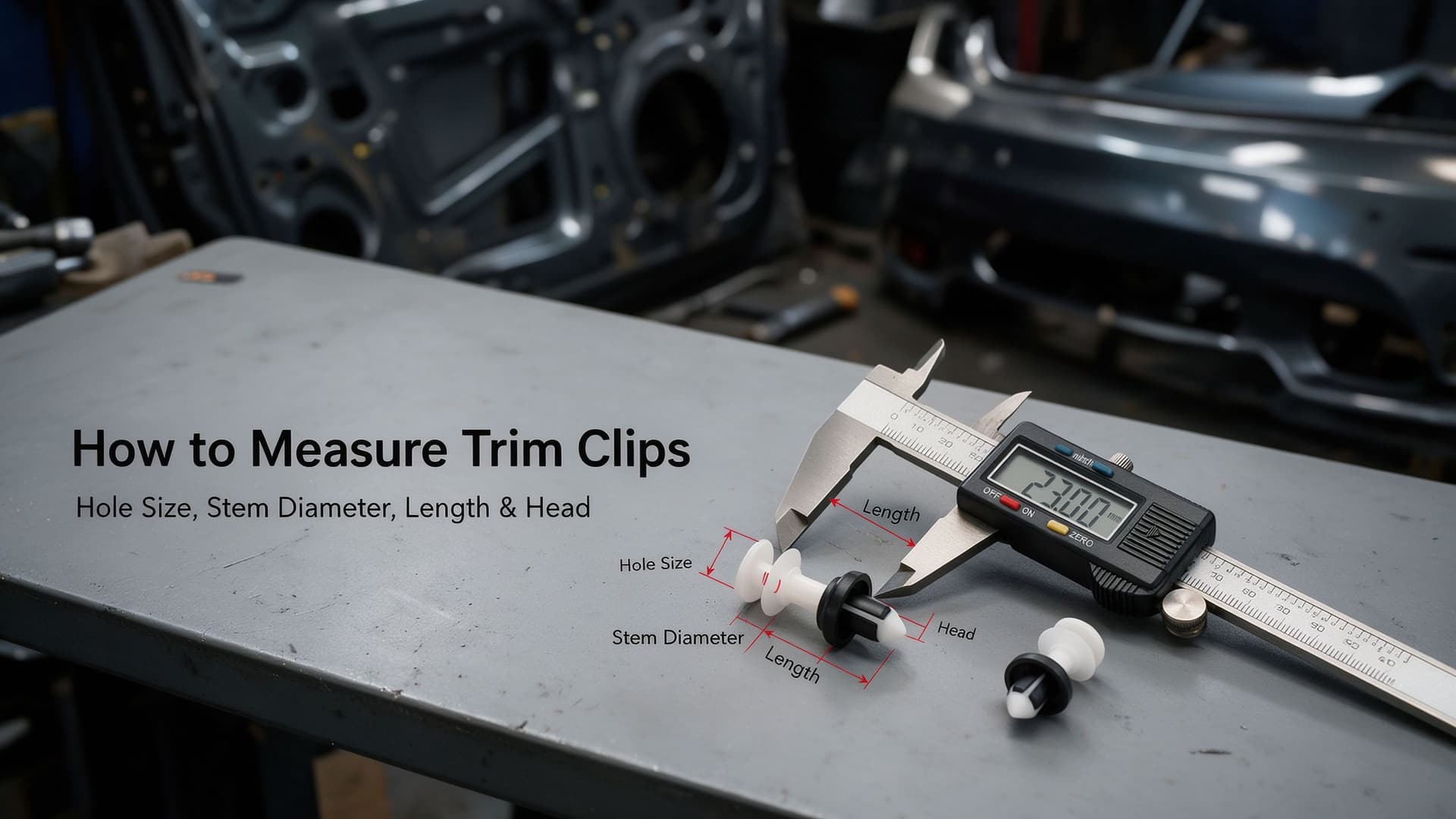
Most trim-clip ordering mistakes happen because the buyer measures only the head, only the hole, or only the overall length. A clip needs to match the mounting hole, panel thickness, stem length and the surface that the head has to hold. Two clips can look identical in a photo and still fit completely differently.
This guide shows the measurements to take, how to measure a broken clip, and which dimensions matter most on door panel clips, bumper clips, fender liner clips and plastic push retainers.
Quick answer
| What to measure | Why it matters |
|---|---|
| Hole size | The barbs must pass through the opening and lock behind it |
| Stem diameter | A loose stem rattles; an oversized stem will not enter |
| Stem length | Sets panel stand-off and how much the retainer can compress |
| Head diameter | Holds the trim board or panel without pulling through |
| Overall length | Useful for comparison, but not enough by itself |
| Mounting type | Push-in, screw-on, slide-on and centre-pin clips are not interchangeable |
Start with the OE or interchange number molded into the original clip. If the number is missing or unreadable, take the measurements below from the old clip or from the mounting point.
1. Measure the mounting hole
Measure the inside diameter of the hole in the door shell, bumper bracket, liner or panel.
Use a digital caliper where possible. For a round hole, measure across the centre in two directions; a worn or distorted hole may not measure the same both ways. For a slotted hole, record the width and length. For a square hole, measure the flat-to-flat opening.
The clip stem must enter the hole without being forced. If the stem is too large, the barbs will scrape or the panel will not seat. If the stem is too small, the clip may pull out or rattle.
| Hole condition | What to check |
|---|---|
| Round | Measure inside diameter in two directions |
| Oval or slotted | Record width, length and orientation |
| Square | Measure flat-to-flat and corner-to-corner |
| Enlarged or torn | Repair the mounting point or use a verified repair method |
A replacement clip cannot reliably fix a torn hole by itself. If the mounting point is cracked, the correct repair may require a larger repair retainer, a new bracket or a panel repair before the clip is fitted.
2. Measure stem diameter
The stem is the part that passes through the hole. Measure the shaft just below the head, away from the locking barbs.
Do not measure across the widest point of the barbs when comparing two clips unless the original specification uses that dimension. Barb geometry changes how the clip enters and releases, so a clip with the same shaft diameter can still behave differently.
This measurement is especially important on plastic push clips used in Hondas, Toyotas, Fords, GM vehicles, BMWs and Volkswagens, where several clips use the same head style but different stems.
3. Measure stem length
Measure from the underside of the head or flange to the tip of the stem.
Stem length controls how far the clip reaches through the panel and how much stand-off it creates. A short stem can lock into the hole without holding the panel at the original height. A long stem may bottom out before the head contacts the trim.
On a door panel, the result can be a card that looks attached but still rattles. On a bumper cover, the gap at the fender can be uneven on one side. On a fender liner, the liner may sit away from the body and rub.
4. Measure head diameter
Measure the widest part of the head that contacts the trim panel, molding or liner.
The head spreads the load. A head that is too small can pull through a soft trim board or an enlarged plastic opening. A head that is too large may contact a neighbouring panel, sit proud or prevent the trim from seating.
Record both the head diameter and the head shape. Common shapes include round, oval, rectangular, low-profile flange and double-flange designs.
5. Check the locking style
Dimensions alone do not identify a clip family.
| Clip type | How it holds | Common use |
|---|---|---|
| Push-in retainer | Barbs expand behind the hole | Door cards, liners, bumper covers |
| Centre-pin clip | A pin locks the barbs open | Bumper and underbody trim |
| Screw-mounted clip | A screw or bolt clamps the retainer | Older trim and brackets |
| Slide-on clip | Grips a flange or panel edge | Moldings and lower valances |
| Double-ended clip | Engages two panels or two layers | Specific VW, Audi and trim applications |
If the original clip has a pin in the centre, remove or release the pin before pulling the panel. Forcing a centre-pin clip can crack the trim board or tear the mounting hole.
How to measure a broken clip
If the stem has snapped off, you may still be able to identify it.
| Remaining piece | What to do |
|---|---|
| Head only | Measure head diameter, flange thickness and the broken stem diameter |
| Stem only | Measure shaft diameter, locking depth and overall length |
| Barbs stuck in panel | Remove them carefully and measure the hole |
| Nothing readable | Measure the mounting hole and compare a photo beside a ruler |
Take a photo of the clip from the top, side and bottom, with a ruler or caliper in the frame. This is more useful than a single photo against an unmarked background.
Do not trust vehicle alone
The same model can use different clips at different mounting points. Front and rear doors, upper and lower trim, bumper cover and lower valance may all use different retainers.
Use the vehicle to narrow the search, then confirm the part number or dimensions:
If the original number is visible, use the MotiveCrate cross-reference search before measuring every dimension.
Common ordering mistakes
| Mistake | Result |
|---|---|
| Matching by head diameter only | The clip enters the hole but does not lock |
| Matching by vehicle only | The model may use several different clips |
| Measuring the barbs as stem diameter | Replacement is too large or too loose |
| Ignoring panel thickness | Stem bottoms out before the panel is tight |
| Reusing a compressed seal | Water leaks or the panel remains loose |
| Buying a metal clip for a plastic application | Corrosion, cracking or panel damage |
A practical measuring checklist
- Write down the OE number.
- Measure the hole.
- Measure stem diameter.
- Measure stem length.
- Measure head diameter.
- Note the head shape and locking style.
- Note whether a seal or foam washer is present.
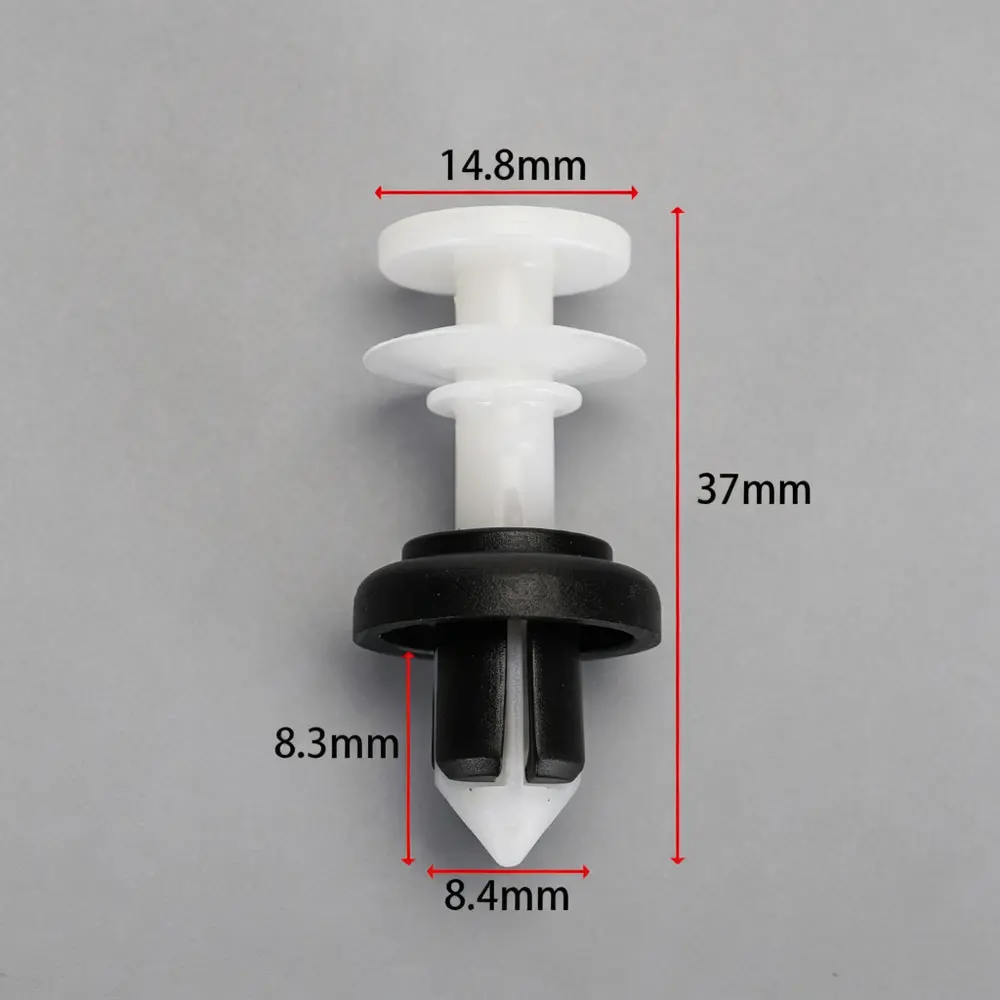
- Compare the result with the product dimensions, not only the photo.
For shop or reseller quantities, keep the measurements on the stock label. A mixed box of similar-looking clips can become unusable once the original bags are opened.
Frequently asked questions
Can I use an 8mm trim clip in a 9mm hole?
Not safely. An undersized retainer may not lock or may pull out under vibration. Match the stem and hole design rather than forcing the closest clip.
Is overall length the same as stem length?
No. Overall length includes the head and any projecting pin. Stem length is measured from the underside of the head to the tip.
Are plastic push clips measured in inches or millimetres?
Both are used. Many original parts are specified in millimetres, while aftermarket listings may include inch fractions. Compare the actual measurement rather than the label alone.
Can I replace a metal clip with a plastic clip?
Only when the load, heat and mounting method are suitable. A plastic retainer should not replace a metal U-nut or bracket fastener that carries a higher load.
What if I cannot find the OE number?
Measure the old clip and mounting hole, then compare the locking style and material. If the number is completely missing, contact MotiveCrate with clear photos and dimensions before ordering.
Parts mentioned in this guide
Replacement options matched to the part type and vehicle applications in this article.
Shop these parts by vehicle
Makes whose parts pages list this guide. Open one to see the models and the exact part numbers we carry for them.
Need help matching a part?
Email [email protected] or message us on WhatsApp with your year, make, model and trim and we will confirm the part number for you.
MotiveCrate supplies aftermarket replacement parts and is not affiliated with any vehicle manufacturer. Fitment information is a compatibility guide — always verify the part number before ordering.