MotiveCrate Guides
Honda Civic Windshield Washer Not Working? (2006-2015)
Honda Civic washer not spraying? Diagnose clogged nozzles, split hoses and failed check valves in five minutes, plus replacement parts for 2006-2015 Civics.
September 18, 2026 · 9 min read · By MotiveCrate
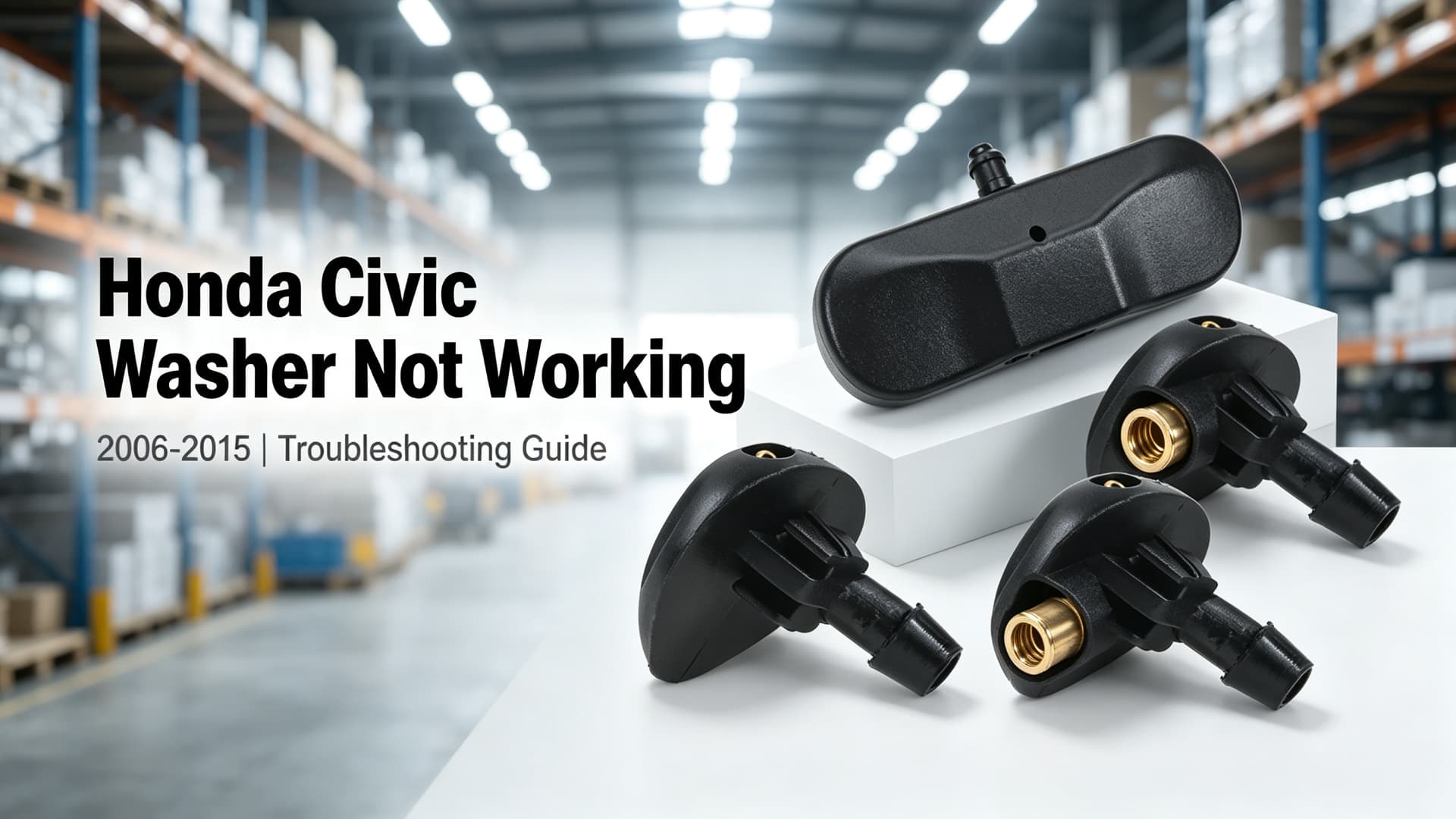
If the windshield washers on your 2006-2015 Honda Civic stopped spraying, you are in good company. It is one of the most common small failures on the 8th-gen (2006-2011) and 9th-gen (2012-2015) Civic, and the good news is that it is usually not the pump.
In the vast majority of cases it is a clogged nozzle, a split hose, or a stuck check valve — all three are driveway-fixable in under an hour with basic hand tools. This guide walks through the five real causes, how to tell them apart in about five minutes, and what to replace.
Quick diagnosis: match your symptom
| What you see | Most likely cause |
|---|---|
| Nothing comes out and you cannot hear the pump | Blown fuse, dead pump, or seized pump motor |
| You hear the pump humming but nothing sprays | Clogged nozzle, blocked or disconnected hose, empty reservoir |
| One side sprays, the other does not | Clogged nozzle or kinked hose on that side |
| Weak, dribbling or uneven spray | Partially blocked nozzle, or a failing check valve |
| Spray is delayed a second or two, then bursts | Failed check valve — fluid drains back into the reservoir |
| Washer fluid puddles under the car | Cracked hose, loose connector, or split reservoir |
| Only fails in winter | Fluid frozen in the line, or summer fluid left in the tank |
1. Clogged or scaled washer nozzles (the most common cause)
Civic washer nozzles are tiny. Road film, wax from the car wash, hard-water mineral scale and pollen all build up inside the spray slot until the nozzle is completely blocked. The pump keeps running, but nothing reaches the windshield.
How to test: pull the hose off the back of the nozzle and run the washer. If fluid shoots out of the hose, the nozzle is blocked. If nothing comes out of the hose, the problem is upstream — go to cause 2.
How to fix: you can sometimes clear a nozzle with compressed air and a pin, but once the internal slot is scaled or cracked, replacement is the reliable answer. Replacement nozzles are inexpensive and snap in from the top of the hood on most Civics.
We stock OEM-numbered washer nozzles for Honda and most other makes. A very common Honda number is 76810-SDA-A11, used across Accord, Civic and Odyssey applications — always confirm against the number moulded on your original nozzle or your VIN before ordering.
→ 76810-SDA-A11 Windshield Washer Nozzle – Honda Accord / Civic / Odyssey
If your original number is different, or you want a direct-fit alternative for a modified or mixed setup:
→ Universal Windshield Washer Nozzle – Honda / Toyota / Mazda / Hyundai / Kia / Suzuki fitments
2. Split, kinked or disconnected washer hose
The washer hose on a Civic runs from the reservoir, up the inner fender, along the underside of the hood, and out to a T-connector that feeds both nozzles. It is thin vinyl tubing, and after 10-20 years of heat cycling it goes hard, cracks at the bends, or pops off a barb fitting.
How to test: have someone press the washer button while you watch and listen along the hose run. A split hose usually shows as fluid dripping onto the ground or onto the inner fender instead of reaching the nozzles. Pull the connector at each nozzle — a loose or brittle hose will slide off with almost no resistance.
How to fix: replace the section, or the whole run if the tubing is hard and cracking in more than one place. A generic hose kit with new T and Y connectors is usually cheaper and faster than chasing individual splits.
→ Windshield Washer Hose Kit – Universal, 5 pcs 2 m Hose with T/Y Connectors
3. Failed check valve (the "delay then burst" symptom)
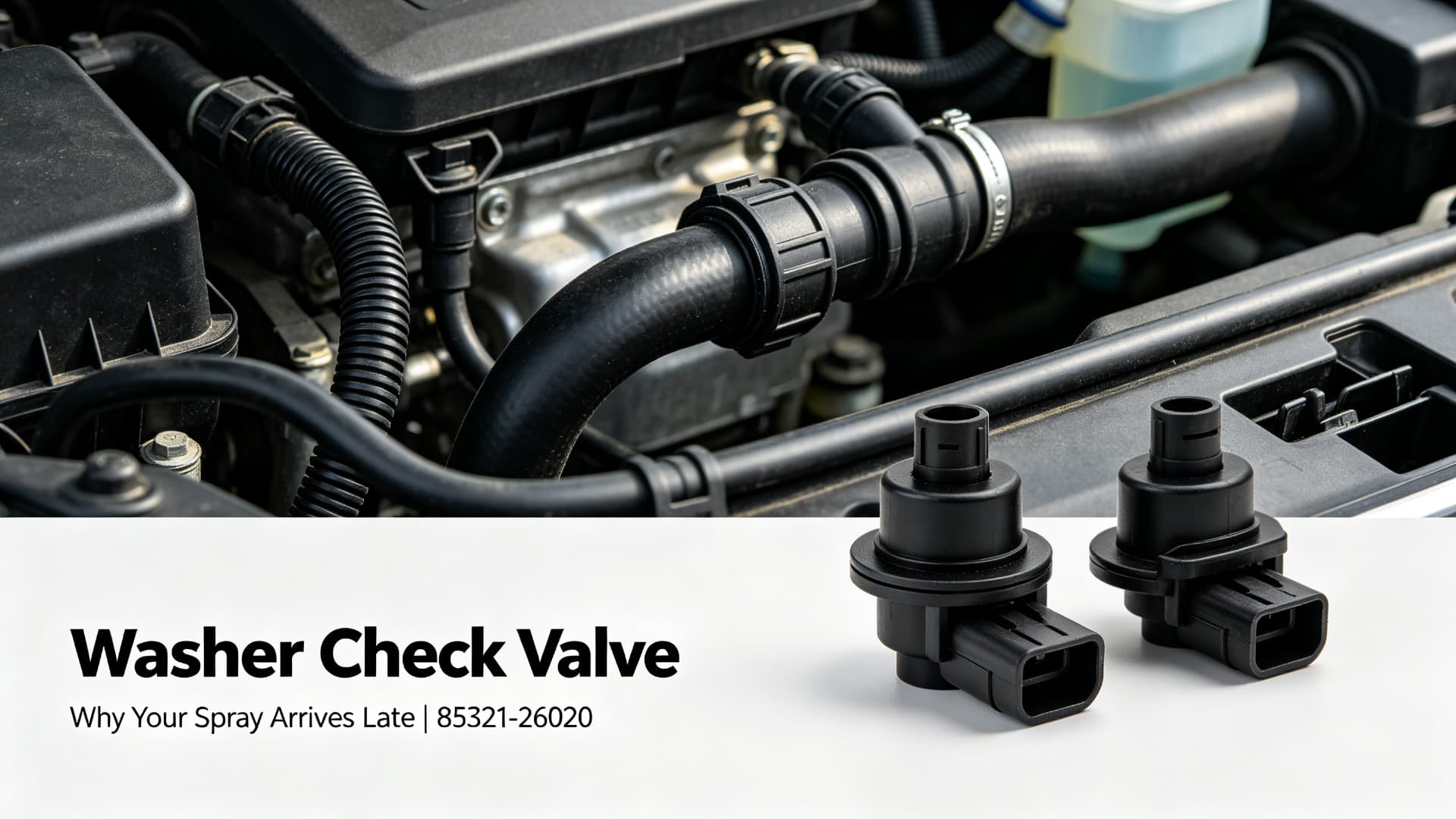
Most Civic washer systems use a small one-way check valve in the line. Its job is to hold fluid in the hose so the spray is instant. When the valve fails open, fluid drains back into the reservoir and you get a one- or two-second delay every time you press the button. When it fails closed, that side stops spraying entirely.
How to test: disconnect the valve and blow through it in both directions. You should be able to blow through one way only. If air passes both ways, or not at all, the valve is done.
Our full washer parts range, including check valves, wiper arm caps and hose kits, is in one place:
→ Shop all Windshield Washer Nozzles & Washer Parts
4. Wrong fluid, or fluid frozen in the line
If you topped up with water or with a summer-formula fluid, a cold snap can freeze it inside the hose and nozzle. Frozen fluid expands and is also a classic cause of cracked nozzles and split hoses, so a "dead" washer in January is often two problems at once.
How to fix: park somewhere warm (or a heated garage) until the system thaws, then flush the reservoir and refill with the correct winter-rated washer fluid for your climate. Never use plain water year-round, and do not run the pump for long periods while frozen — that is how pumps burn out.
5. Washer pump, fuse or wiring (check this last)
If you cannot hear the pump at all, the problem is electrical. Check the washer fuse first — it is the cheapest fix by far. If the fuse is fine, unplug the pump connector and check for 12V while someone presses the washer button. No voltage means a wiring, relay or switch issue; voltage present with no pump noise means the pump itself has failed.
Five-minute test order
- Listen for the pump. Silent? Check the fuse.
- Pull the hose off one nozzle and press the button. Fluid at the hose, no spray at the glass = replace the nozzle.
- No fluid at the hose? Work backwards along the hose for splits, kinks and disconnected joints.
- Spray delayed but eventually strong? Replace the check valve.
- Everything frozen? Thaw, flush, refill with winter fluid.
Frequently asked questions
Why does only one washer nozzle work on my Civic?
Almost always a blocked nozzle on the dead side, or a kinked/disconnected hose branch after the T-connector. Swap the nozzles left to right — if the fault follows the nozzle, the nozzle is the problem.
Can I clean a Civic washer nozzle instead of replacing it?
You can try compressed air or a fine pin, and it sometimes works. But if the spray pattern stays uneven or the slot is scaled or cracked, replacement is the cheaper long-term fix.
Is 76810-SDA-A11 the right nozzle for my Civic?
It is a Honda nozzle used across many Accord, Civic and Odyssey applications, but Honda changed part numbers by year and trim. Always confirm against the number on your original nozzle or your VIN before ordering. If you are unsure, contact us and we will help you check.
Do you sell wholesale or bulk quantities of washer nozzles?
Yes. We supply repair shops, detailers and resellers in the US, Canada and Mexico. Email service@motivecrate.com or message us on WhatsApp +1 279-200-4690 for bulk pricing.
Civic washer nozzle replacement: step-by-step
Replacing a washer nozzle on an 8th- or 9th-gen Civic is a basic DIY job. Use plastic trim tools and work gently, because the hood and cowl plastics are old on many 2006-2015 cars.
- Confirm the part number first. Remove the old nozzle or read the number moulded into it. On many Civics the nozzle is held by two plastic tabs, and the washer hose pushes onto a barb underneath.
- Disconnect the hose. Pull the washer hose off the back of the nozzle. Have a rag ready, because the line may still hold fluid.
- Release the nozzle. Press the retaining tabs and lift the nozzle out. If it is stuck, use a plastic trim tool; do not pry against the paint with a metal screwdriver.
- Test before final fitting. Connect the hose, press the washer button briefly, and check the spray pattern. Uneven spray usually means debris in the nozzle or a kinked hose.
- Seat it and test again. Push the nozzle in until the tabs click, then run the washers and check for leaks around the base.
If both sides are weak or delayed, replace the check valve or hose as well instead of replacing the second nozzle unnecessarily.
Tools and parts that help
- Plastic trim tool
- Small pick or low-pressure compressed air for cleaning
- Replacement nozzle, hose kit or check valve
- Winter-rated washer fluid
2006-2011 vs 2012-2015 Civic: what to check first
The 8th-gen Civic (2006-2011) and 9th-gen Civic (2012-2015) use similar washer-system layouts, but the age-related failures differ.
- 2006-2011 Civic: hoses and plastic connectors are older, so check for brittle hose, cracked T-connectors and clogged nozzles before condemning the pump.
- 2012-2015 Civic: still check the nozzle first, but also inspect the hose routing under the hood and the check valve if the spray is delayed.
In both generations the diagnosis order is the same: confirm the pump runs, check the hose for flow, then replace the nozzle or check valve.
Where is the Civic washer fuse?
Honda moved fuse-box layouts between trims and model years, so there is no single fuse number that applies to every 2006-2015 Civic. Check the under-hood fuse box label and your owner's manual for the washer or wiper circuit. If the fuse is good, test the pump connector for 12V while an assistant presses the washer button. That tells you whether the problem is electrical or hydraulic.
How to prevent Civic washer problems
- Use winter-rated washer fluid before the first freeze.
- Do not use plain water or household soap; both can clog the nozzle and shorten pump life.
- Flush the reservoir if the fluid looks cloudy or smells stale.
- Clear wax and road film from the nozzle slot after car washes.
- Check the hose at the hood hinge and T-connector once a year; that is where heat and movement cause cracks first.
More Civic washer FAQs
Can I use compressed air to clear a Civic washer nozzle?
Yes, low-pressure compressed air can clear loose debris. Do not use high pressure, and never force a metal pin through the spray slot; the nozzle insert is easy to deform.
Why does my Civic washer spray go over the roof or miss the windshield?
The nozzle is usually clogged, partially blocked or misaligned. Clean or replace the nozzle, then aim it at the middle of the windshield. If the spray pattern is still wrong, compare it with the other side.
Should I replace both Civic washer nozzles at the same time?
Not always. If one side is blocked and the other sprays correctly, replace only the faulty side. If both are original and the plastic is brittle, replacing both is usually cheaper than paying for a second repair later.
Can a bad check valve cause weak spray instead of no spray?
Yes. A partially stuck valve can restrict flow, while a valve that fails open causes the delay-then-burst symptom. If the pump runs and the hose flows well, the check valve is a likely culprit.
Related parts for 2006-2015 Honda Civic
- 76810-SDA-A11 Windshield Washer Nozzle - Honda Accord / Civic / Odyssey
- Universal Windshield Washer Nozzle - Honda / Toyota / Mazda / Hyundai / Kia / Suzuki fitments
- Windshield Washer Hose Kit - Universal 5 pcs 2 m Hose with T/Y Connectors
- Shop all Windshield Washer Nozzles & Washer Parts
Fitment information in this guide is a compatibility reference only. Always verify the exact part number for your vehicle's year, model and trim before purchase. MotiveCrate is not affiliated with or endorsed by Honda.
Need help matching a part?
Email service@motivecrate.com or message us on WhatsApp with your year, make, model and trim and we will confirm the part number for you.
MotiveCrate supplies aftermarket replacement parts and is not affiliated with any vehicle manufacturer. Fitment information is a compatibility guide — always verify the part number before ordering.