MotiveCrate Guides
Four Clip Jobs: Why a Door Card, a Cargo Hook, a Hood and a Bumper Clip Are Not the Same Fastener
Four retainers that look interchangeable and are not: what each one holds, why vibration, load, heat and visible gap force four different designs, and the part numbers, year ranges and pack sizes for each.
Published October 9, 2026 · Updated October 9, 2026 · 9 min read · Reviewed by MotiveCrate
Quick answer
The four retainers look interchangeable, but each solves a different mechanical problem. The Volvo 39964090 locates a door card with a firm, releasable grip. The Nissan 79916-D1000 carries the repeated pull load of a cargo hook. The 6503339 hood retainer survives heat, UV and hood-area vibration. The Honda 71592-S5D-000 sets a visible body or bumper panel gap and helps seal the mounting point. Match the OEM number first, then verify stem diameter, stem length, shoulder height, barb geometry and material. A clip that clicks into place can still be the wrong part for the job.
Most clip guides are organized by where the clip is. This one is organized by what the clip has to do, because that is what explains the shape of the part in your hand.
Four retainers, four jobs. All four are press-on plastic fasteners of similar size, and a buyer sorting by appearance would call them interchangeable. They are not.
| Job | Retainer | What it holds | Why the design differs |
|---|---|---|---|
| Locate a trim panel | 39964090 | Volvo door card | Vibration and repeated removal, minimal load |
| Carry a load | 79916-D1000 | Cargo cover hook | A hard pull, one direction, repeatedly |
| Resist heat and UV | 6503339 | Hood top-stud retainer | Engine bay heat cycling, sun exposure |
| Set a visible gap | 71592-S5D-000 | Honda body and bumper molding | Cosmetic alignment, water ingress |
Job one: locating a trim panel
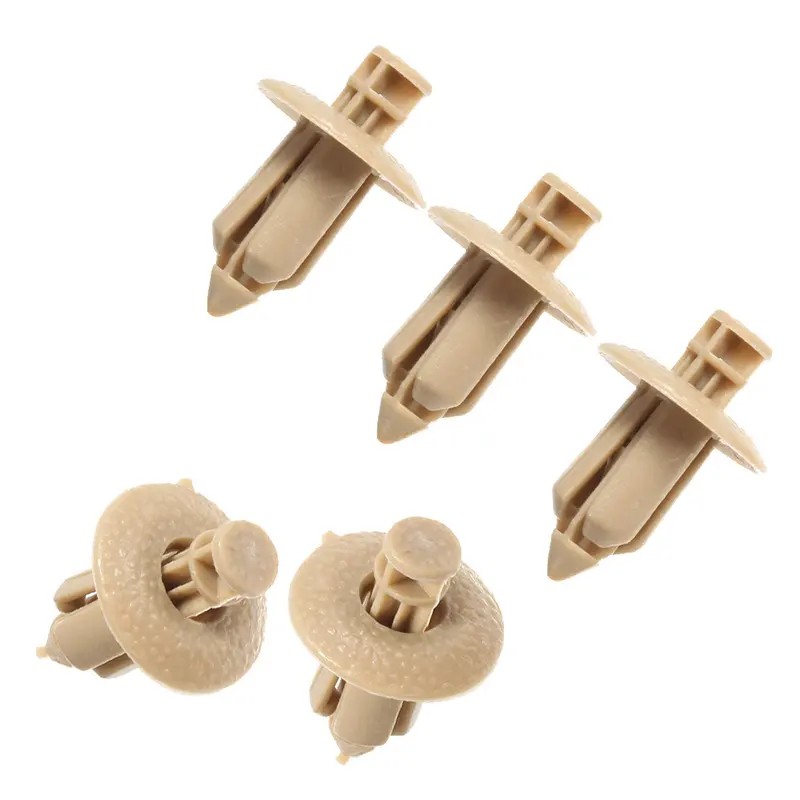
39964090 — Volvo door trim clip, S40 / S60 / S80 / XC70, 2000–2016
A door card is a large, light panel held at eight to fourteen points. The clip does not carry weight. It holds the panel at a consistent stand-off so it does not move, and releases predictably when somebody pulls the card off to reach a window regulator.
Hold firm but release on demand is the whole design brief. The barbs must grip hard enough that the panel does not buzz at speed, and not so hard that removing the card tears the socket out of the trim board. A retainer tuned for a permanent fixing is a liability here, which is why a general-purpose clip on a door card usually ends with a torn board rather than a rattle.
The range covers 2000–2016 across four models, so one number spans several generations. Convenient for stock, and a trap: confirm the model code, not the marketing name.
Job two: carrying a load
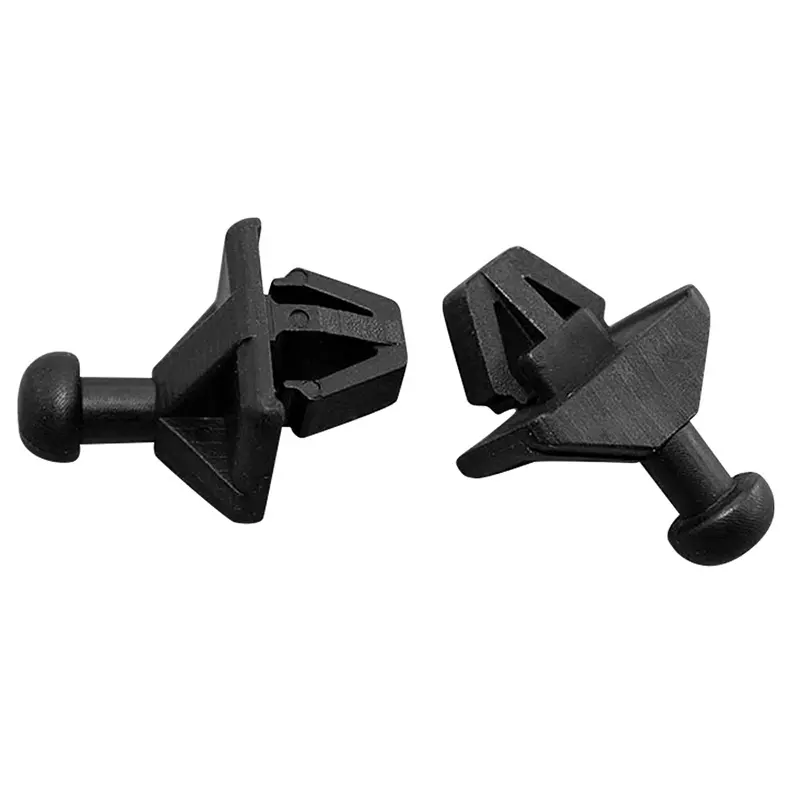
79916-D1000 — Nissan cargo hook trim clip, 2014–2024 Kicks and Versa Note
A cargo cover hook is grabbed by a person. It takes a sharp, off-axis pull every time somebody lifts the cover, and it has to survive that thousands of times without walking out of its hole. A door card clip never sees that — you pull a door card deliberately, with a trim tool, from a good angle.
The consequence is that a tired load-bearing retainer does not rattle, it falls out. There is no panel preload to hide the failure, so the tolerance for a used clip is far lower here than on a door card.
Worth knowing about this number: the stated application is 2014–2024 Kicks and Versa Note, and the same fastener cross-references against Porsche, BMW, Land Rover, Volvo and Toyota applications. That breadth is normal for trim fasteners and it is exactly why matching by number beats matching by shape.
Job three: resisting heat and UV
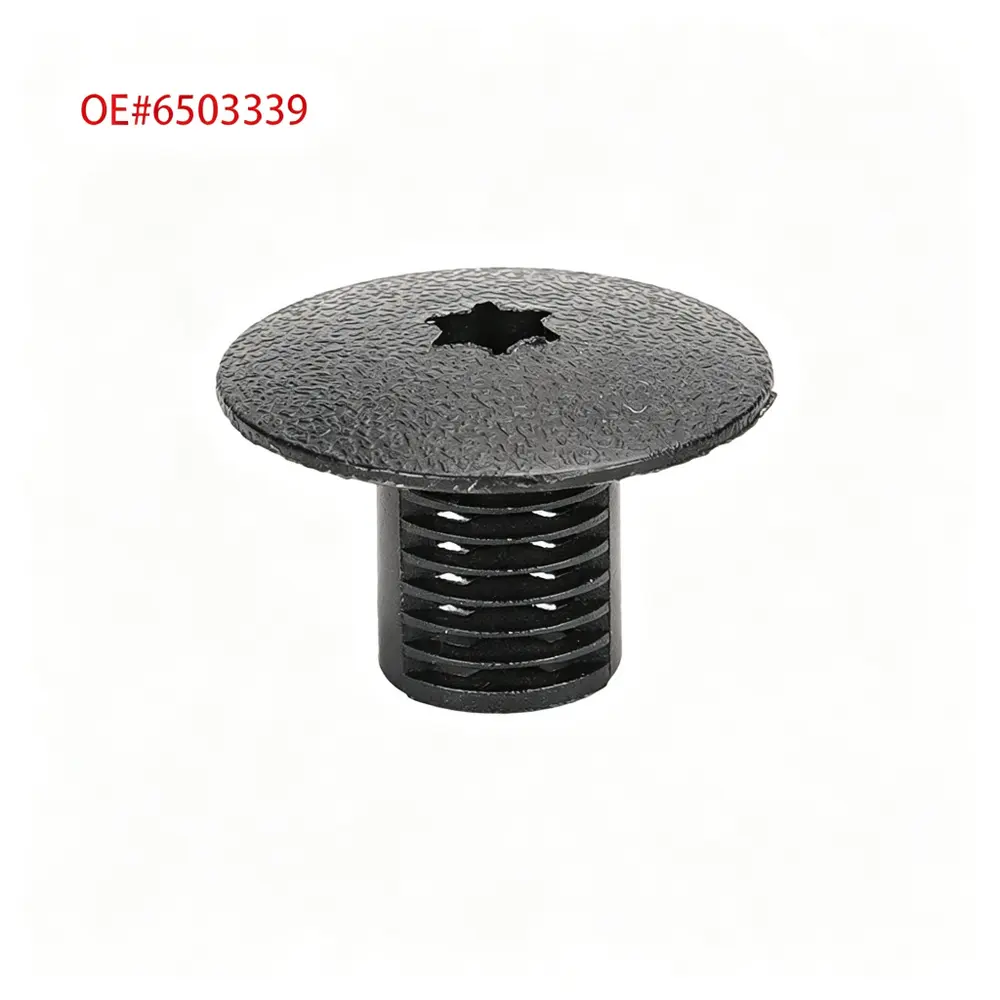
6503339 — hood top-stud retainer clip, Chrysler / Dodge / Ram / Jeep, 2001–2007
A hood-area retainer lives in the harshest environment of the four: engine bay heat, direct sun on a horizontal surface, and constant cycling between the two. Plastic that is fine inside a door card goes brittle faster up here, and a brittle clip does not fail gradually. It snaps, and the panel it held starts to move.
The mounting method matters too. This is a top-stud retainer — it presses onto a stud rather than into a hole. A stud retainer levered like a push-in clip will break, because there is nothing for the barbs to release from; you are pulling against the stud itself.
Listed applications cover Chrysler, Dodge, Ram and Jeep hood and cowl top-stud positions including Ram, Durango, Dakota, Grand Cherokee and Patriot.
Job four: setting a visible gap
71592-S5D-000 — Honda body and bumper clip, 2001–2005 Civic and Accord, plus later compatible applications
This is the job where the clip's dimensions are visible from outside the car.
A bumper or body molding retainer does not just hold the panel on, it sets the panel gap. If the stem is a millimeter short the molding sits fractionally low, and the seam against the next panel is wrong — a defect the owner notices from three meters away.
That is why a body clip is the least forgiving of the four on dimensions, and why one that "clicks in fine" can still be the wrong part. It is also why these fasteners often carry a sealing washer or foam gasket: the joint that sets the gap is also a water path, and water at a mounting hole is how a clip failure becomes rust.
Four different failure profiles
Door trim clips lose grip slowly and come back as a rattle. Replace them every time a panel is opened.
Load-bearing retainers release suddenly, with no early warning. Hold depth on these rather than a couple of spares.
Hood and engine-bay retainers go brittle with heat, and the second failure can drop a panel. Reuse is a false economy here more than anywhere else.
Body and molding clips set the wrong gap. A comeback is a visible defect, which makes it the most expensive failure of the four in customer confidence — while costing the least.
What does not transfer between them
Stem diameter decides whether the clip seats in the hole. It most often disqualifies a candidate, and it is invisible in a photograph.
Stem length and shoulder height set the stand-off — panel preload on a door card, visible gap on a body molding.
Barb geometry is matched to the substrate. Sheet metal takes one profile, a moulded plastic boss takes another, and metal barbs in a plastic boss will hold and then crack it.
Material is matched to the environment. The hood retainer and the door card clip are not the same compound.
The rule that comes out of all four: read the number off the old clip, and if you cannot, measure stem diameter first. Where the number is unreadable, our OEM cross-reference lookup will match one you do have, and the retainer matching guide covers head shape, barb design and panel slot.
What the symptom tells you
| Symptom | Likely job | What it means |
|---|---|---|
| Buzz or rattle at speed, panel attached | Trim location | Clip has lost preload. Holding, not clamping |
| Clip in the footwell, panel dropped | Trim location | Barb released — stem diameter mismatch, or an aged barb |
| Cargo hook pulls away under load | Load bearing | Grip failed outright. No early warning stage |
| Wrong panel height, visible gap | Visible gap | Stem length or shoulder height off, though it "clicks" |
| Clip snapped rather than released | Heat and UV | Compound embrittled. Common in engine bay positions |
The first two rows matter most for a shop, because they look identical to a customer and are not the same repair. A rattling panel needs a clip. A dropped panel has already failed and may have damaged the mounting socket on the way out. One is ten minutes; the other can be a door card.
Why a universal kit cannot cover four jobs
An assortment kit is built around the sizes that sell in volume, and those sizes are driven by the jobs appearing across the most vehicles — in practice light interior trim, splash shields and bumper covers. A kit cannot tune one size to four jobs, because the four jobs want four different trade-offs: firm-but-releasable, high grip, heat-resistant, dimensionally exact.
The kit is not the problem. Buying the kit instead of the number is.
Ordering
All four are in stock in 20, 50 and 100-piece packs, and each sits in the collection its job belongs to:
- 39964090 Volvo door trim clip — Door Panel Clips
- 79916-D1000 Nissan cargo hook trim clip — Trunk Clips
- 6503339 hood top-stud retainer — Hood Clips
- 71592-S5D-000 Honda body and bumper clip — Bumper Clips
If the number is unreadable, send stem diameter, stem length, head diameter and the hole it seats into, with a photograph of the clip next to a ruler. For trade quantities, part numbers, delivery country and packaging requirements go through the wholesale form — mixed cartons ship for the US, Canada and Mexico, and neutral or private-label packaging is available if you resell. Related reading: door panel removal, door panel rattle, bumper clips, grille clips.
Fitment ranges stated here are the applications we can document and are a compatibility guide, not a guarantee. Production runs vary by model code, engine and market, so verify the part number against the part you removed before ordering.
Parts mentioned in this guide
Replacement options matched to the part type and vehicle applications in this article.

Need help matching a part?
Email [email protected] or message us on WhatsApp with your year, make, model and trim and we will confirm the part number for you.
MotiveCrate supplies aftermarket replacement parts and is not affiliated with any vehicle manufacturer. Fitment information is a compatibility guide — always verify the part number before ordering.