MotiveCrate Guides
Three of These Four Are Not Push-Clips: What to Do When the Fastener Is a C-Clip Nut, a Stud or a Bracket
A C-clip nut, a seat retainer, a brake line bracket and one genuine push-clip: how each actually releases, why levering a threaded fastener wrecks it, and the part numbers, year ranges and pack sizes for all four.
Published October 15, 2026 · Updated October 15, 2026 · 8 min read · Reviewed by MotiveCrate
Most automotive trim fasteners are push-in clips: barbs into a round hole, pull straight, it releases. The four in this article are not, and treating them like push-clips is how people break things, strip threads, or leave a brake line loose.
Two of the four are safety components. The solutions below are written accordingly.
| Part number | What it actually is | Vehicle | Years | Packs |
|---|---|---|---|---|
| 07146951655 | Metal C-clip self-locking nut, ST4.8 | BMW, MINI | 2004–2016 | 25 / 50 / 100 |
| 4076409 | Seat trim / cushion retainer | Ford Fiesta, Focus, KA, Mondeo, Puma | 2014+ | 1 / 2 / 5 |
| 5Q0611797B | Brake line retainer bracket | Volkswagen, Audi | 2012 | 6 / 12 / 24 |
| 91560-SLJ-J01 | Trunk trim clip | Honda, Acura | 2007–2017 | 20 / 50 / 100 |
A C-clip nut is threaded, so never lever it
07146951655 — screw and spring clip, MINI / BMW, 2004–2016. Listed as a C-clip self-locking nut, ST4.8-ZNS3.
This is a spring-steel nut that slides over the edge of a panel or a stud and grips by spring tension. It is not pushed in and it does not release with a pull. It comes off by unscrewing the fastener holding it, then sliding the clip off the edge.
The solution, in order:
- Find the screw or bolt first. The clip is the nut; something threads into it. If you cannot find the fastener, you are looking at the wrong side of the panel.
- Undo the fastener by hand for the first turn. If it does not start by hand, it is cross-threaded, and a driver will finish the damage. Back it out and start again.
- Slide the clip off the edge, do not lever it. A C-clip has a spring leg that hooks over the panel edge. Levering bends that leg, and a bent leg no longer grips — the fastener will feel tight and still rattle.
- Replace the clip, not just the screw. A C-clip that has been off and back on has lost spring tension at the point where it gripped before. At this price there is no argument for reuse.
- If the stud spins instead of the nut, stop. That means the stud is no longer fixed to its panel, and turning it further enlarges the hole. That is a panel repair, not a fastener job.
Packs are 25, 50 and 100 pieces.
A seat cushion clip is a safety part — replace it every time
4076409 — seat clip, Ford / Land Rover / Jaguar / Mazda. Listed applications are Ford Fiesta, Focus, KA, Mondeo and Puma, 2014 onward, for rear seat trim and cushion retention.
A seat cushion or seat trim retainer is holding something a person sits on. A trim rattle in a door card is an annoyance; a rear seat cushion that shifts under a passenger is a different category of problem.
The solution:
- Never reuse this clip. Not “inspect and decide” — replace. The loads are human body weight plus vibration, and a clip that has taken that load has already deformed.
- Check every clip position on the seat, not just the failed one. These clips fail in groups, because they all carried the same load. If one has released, the ones beside it are fatigued.
- Confirm the seat latches before you drive. After refitting, push down hard on the cushion at the front edge and listen for the latch or retainer engaging. Do not test it by sitting — test it by hand with the seat empty.
- If the cushion still moves after new clips, stop using that seat position and inspect the seat frame. A retainer that will not hold on new clips usually means the frame or the mounting point has deformed, and no clip will fix that.
Note the pricing here is per small pack — 1, 2 and 5 pieces — rather than the 20/50/100 of a trim clip. That is a signal about the part: it is a low-count, higher-load fastener, not a panel-run clip. Buy the number of positions you need.
A brake line retainer is not a trim clip, and the torque rule is different
5Q0611797B — brake line retainer / bracket, Volkswagen / Audi, 2012.
This is the one in the group where getting it wrong has consequences beyond a rattle. The retainer holds a rigid or semi-rigid brake line against the body, and it does two jobs: it keeps the line from moving, and it keeps it away from anything it could chafe against.
The solution:
- Support the line before you release the retainer. A brake line that drops onto a suspension component or is left hanging puts load on the flare or the hose union. Hold it with a tie or a second hand.
- Do not let the line twist. Twist is what cracks a hard line at the union. When you move it, move it in the direction the pipe already runs.
- Refit the retainer at the same point on the line. Reusing the original position keeps the routing clearances exactly as designed. If the old retainer is broken, fit a new one at the same spot rather than cable-tying to something nearby — a tie has no stand-off, and stand-off is the whole function.
- Check clearance along the whole run, not just at the clip. With the retainer fitted, look along the pipe for any point where it is now closer than a finger-width to another component. Chafing is the failure this part exists to prevent.
- If the line was disturbed, check the pedal before moving the car. Firm, non-spongy pedal with the engine off, then with it running. If anything feels different from before the job, do not drive it — that is a brake system fault, not a clip fault.
- Torque here matters. Unlike a panel clip, a bracket fastener that is overtightened can crush a line and one that is loose lets it move. Use the vehicle’s figure; do not tighten by feel.
Packs are 6, 12 and 24 pieces.
A trunk trim clip is the straightforward one — here is the sequence
91560-SLJ-J01 — trunk trim clip, Honda / Acura, 2007–2017.
This is the one genuine push-in clip of the four, and it is included because it is the case where the standard method applies fully.
The solution:
- Work at the panel edge, not the middle. Trunk and boot trim is thin board covered in fabric; the middle flexes and the edge is where the clips are.
- Use a trim tool, slide under, lift progressively. Same as any door card clip. A screwdriver concentrates load and cracks the board.
- Pull straight. Never twist. Torsion shears barbs — this is the most common way a push-clip breaks.
- Warm the panel in cold weather. Trim board goes brittle below freezing and a clip that would release in summer will tear the board in winter. Ten minutes with the cabin heater on saves the panel.
- Replace all of them while the panel is off. Trunk trim comes off rarely, so the labour to go back in is the expensive part. A 20-piece pack covers most boots with spares.
- If the panel rattles after refitting, one clip is not seated. Press along the edge with a flat hand and find the point that moves. It is faster than removing the panel again.
Packs are 20, 50 and 100 pieces.
The rule that separates these four
The single decision that matters: is the fastener threaded or pressed?
A threaded fastener — a C-clip nut, a bracket bolt — comes off by unscrewing. Levering it damages the spring leg or the stud, and the damage is invisible until the fastener fails later. A pressed fastener comes off by pulling straight. Confusing the two is the whole risk.
The second rule is about consequence. A trunk trim clip failing is a rattle. A seat retainer failing is a passenger moving in a crash. A brake line retainer failing is a line that chafes. When the consequence is not cosmetic, the answer is not “inspect and reuse” — it is replace, and check the system it belongs to, not just the clip.
Ordering
All four are stocked in the collections their position belongs to:
- 07146951655 C-clip spring nut — Screw & Bolt Clips
- 4076409 seat clip — Seat Clips
- 5Q0611797B brake line retainer — Bumper Clips
- 91560-SLJ-J01 trunk trim clip — Trunk Clips
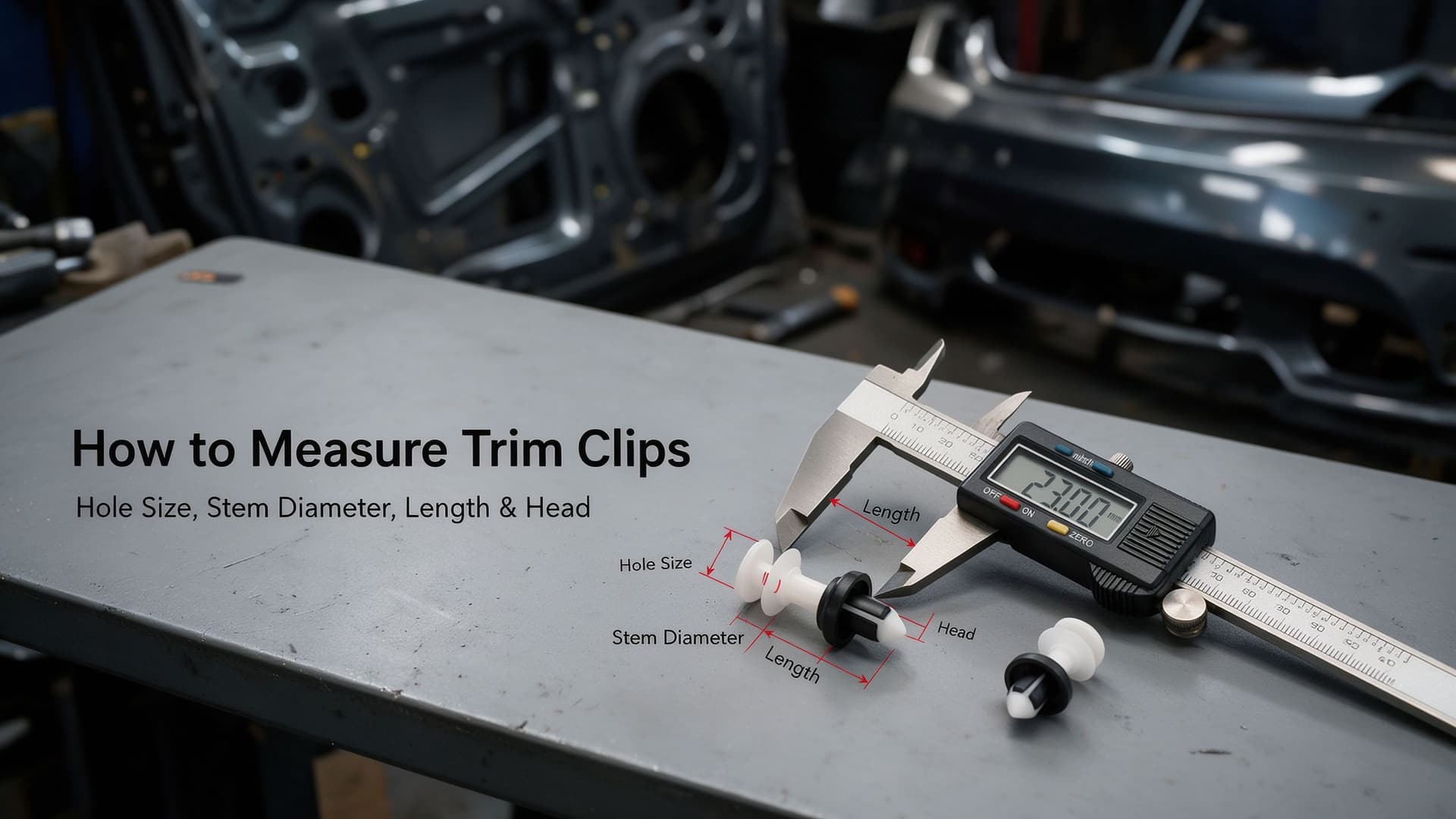
If you have the number off the old part, send it. If the number is unreadable, send stem diameter, stem length, head diameter and the hole it seats into, with a photograph of the part next to a ruler. For trade quantities and delivery country, use the wholesale form — mixed cartons ship for the US, Canada and Mexico, and neutral or private-label packaging is available.
Fitment ranges are the applications we can document and are a compatibility guide, not a guarantee. Production runs vary by model code, engine and market — verify the part number against the part you removed before ordering. Brake and seat components should be inspected by a qualified technician if you are unsure of the condition of the surrounding system.
Need help matching a part?
Email [email protected] or message us on WhatsApp with your year, make, model and trim and we will confirm the part number for you.
MotiveCrate supplies aftermarket replacement parts and is not affiliated with any vehicle manufacturer. Fitment information is a compatibility guide — always verify the part number before ordering.