MotiveCrate Guides
Windshield Washer Nozzle Buying Guide: Part Numbers, Spray Patterns & Fitment
Windshield Washer Nozzle Buying Guide: Part Numbers, Spray Patterns & Fitment - How to find the right windshield washer nozzle for your car: match the OEM part number, understand spray patterns and check valve fitment. Part-number tables by brand. | MotiveCrate
September 21, 2026 · 10 min read · By MotiveCrate
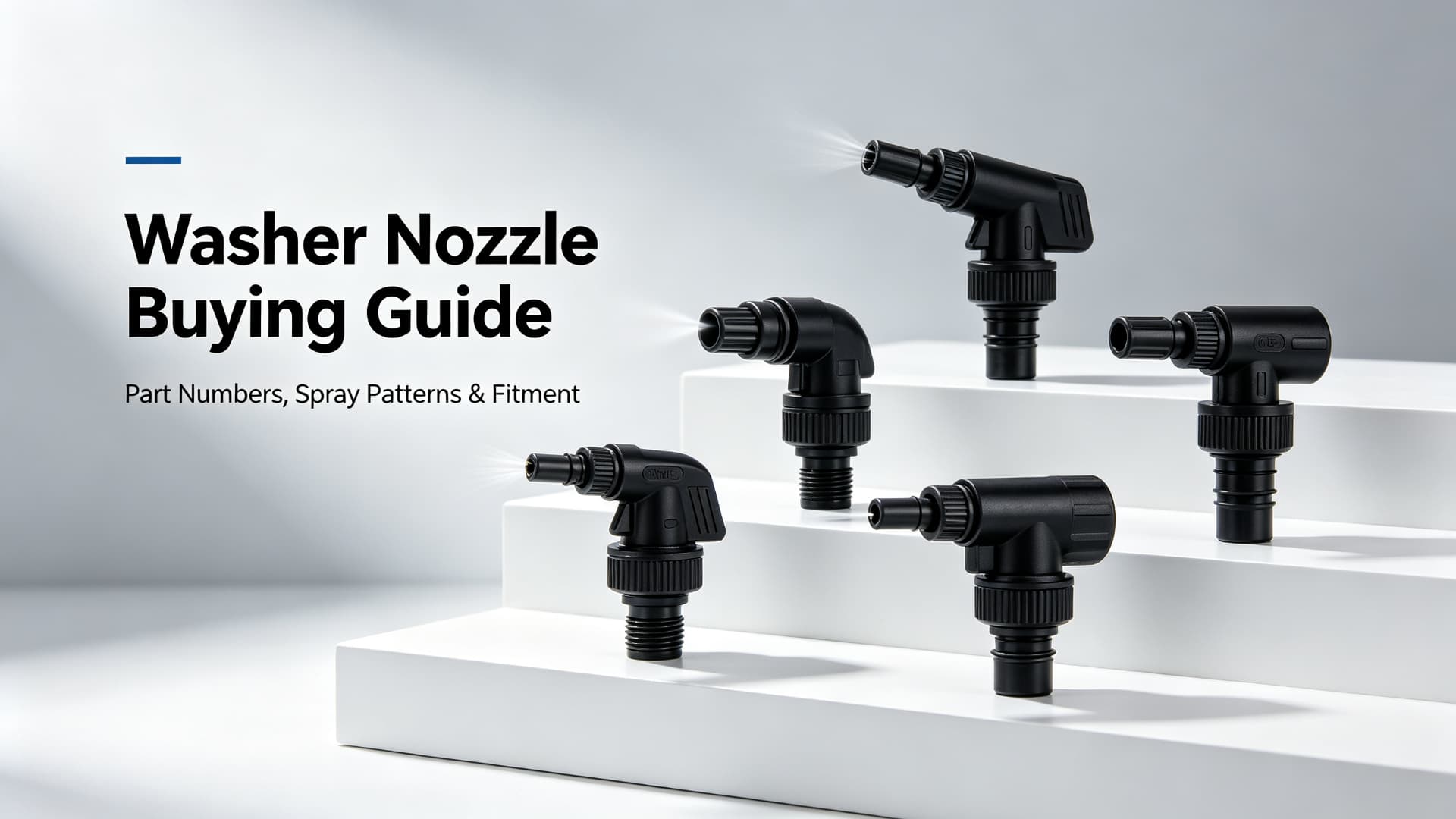
A windshield washer nozzle is a small, model-specific part — not a universal one. In almost every case you should match the OEM part number stamped on your original nozzle, or look up the number for your exact year, make, and model. Universal nozzles exist and can work, but they usually require adjusting the spray angle and may not clip into the factory opening. This guide shows you how to find the right number for your vehicle, what "spray pattern" actually means, and how to avoid the three mistakes that cause most returns.
Start here: the 60-second decision
| Your situation | What to buy |
|---|---|
| You know your OEM part number | Buy that exact number — it will fit |
| You don't know the number, but know year/make/model | Look up your model in the tables below |
| Your nozzle is clogged but not broken | Try cleaning first — see section 8 of this guide |
| Your nozzle sprays but the pattern is wrong | Still a fitment issue — check the number |
| You need it for a shop or reseller | See our wholesale program |
1. Why washer nozzles are part-number parts
A washer nozzle does three jobs at once, and all three are vehicle-specific:
- It clips into the hood, cowl, or wiper arm — the mounting tab shape differs by model.
- It aims fluid at a specific spot on the glass — the spray angle is set by the housing geometry.
- It connects to a specific hose size and routing — some include a built-in check valve, some don't.
That is why a nozzle that "looks the same" often is not. The housing angle that works on a Honda Civic windshield will not aim correctly on a Subaru Outback.
Rule of thumb: if you are replacing a nozzle because of a fitment problem (won't clip in, sprays over the roof, misses the glass), the part number is almost always the cause.
2. Where to find your OEM part number
Four places, in order of reliability:
- On the old nozzle itself — often molded into the plastic housing, or on a small sticker. This is the most reliable source.
- Your vehicle's parts diagram — the number is usually printed near the nozzle in the exploded view.
- The dealer parts counter — give them your VIN and they will return the exact number.
- Our part-number lookup below — we list the numbers we stock by brand and model.
Write the number down before you search. Searching by part number is far more reliable than searching "washer nozzle for my car," because the same model year can use different nozzles depending on trim and plant.
3. Part-number lookup by brand
The table below lists washer nozzles we stock, by OEM number and the models they are built for. Always confirm your number matches before ordering.
| OEM Part Number | Fits | Type | Verify |
|---|---|---|---|
| 76810-SDA-A11 | Honda Accord / Civic / Odyssey | Windshield nozzle | Trim & year |
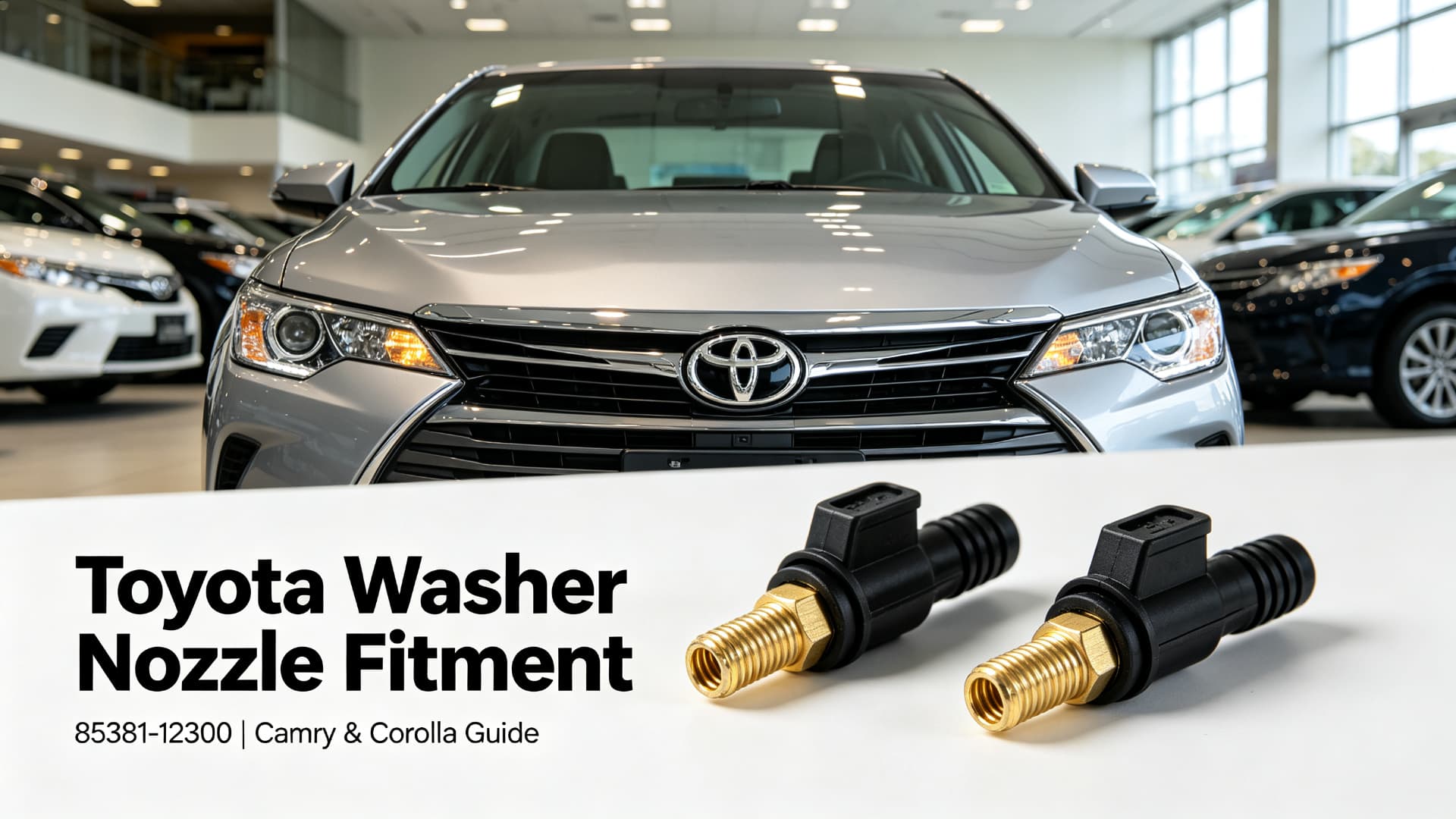
| 85381-12300 | Toyota Camry / Corolla | Windshield nozzle | Year range |
| 2KD955985 | VW Jetta / Golf / Passat / Tiguan / Touareg | Windshield nozzle | Year range |
| 8K9955985A | Audi A3 / A4 / A6 / Q5 / Q7 | Windshield nozzle | Chassis code |
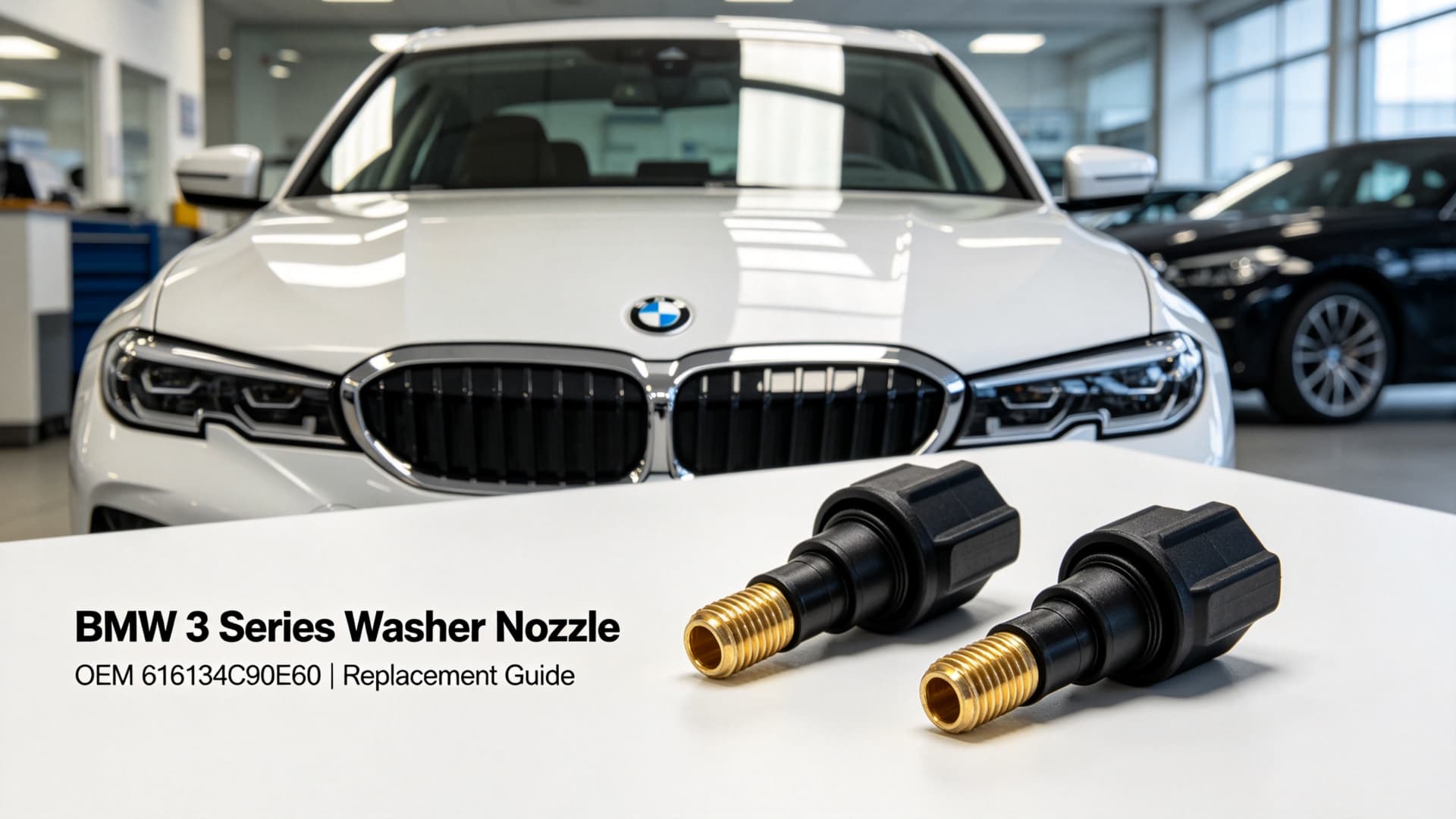
| 8iME36E90E60 | BMW 3 Series | Windshield nozzle | E90 / chassis |
| 986303J000 | Kia Sportage | Windshield nozzle | Year range |
| 98630-3X900 | Hyundai Elantra / Kia Rio | Windshield nozzle | Year range |
| 98630-YY000 | Hyundai / Kia Sportage | Windshield nozzle | Year range |
| 28882-AU300 | Nissan / Infiniti / Lexus | Wiper arm cap | Model |
| 28932-JD000 | Nissan Qashqai / X-Trail | Windshield nozzle | Year range |
| 28932-9U000 | Nissan / Infiniti | Windshield nozzle | Year range |
| 55079049AA | Jeep Grand Cherokee / Commander | Windshield nozzle | Year range |
| 30655605 | Volvo S40 / S80 / XC90 | Windshield nozzle | Year range |
| 30655606 | Volvo S60 / V70 / XC70 | Windshield nozzle | Year range |
| AR3Z17603A | Ford Explorer / Mustang | Windshield nozzle | Year range |
| BM5117666AB | Ford Focus / BMW Mini | Windshield nozzle | Year range |
| 61667061614 | Mini Cooper R50 / R52 / R53 | Windshield nozzle | Chassis code |
| 15778747 | Cadillac SRX / STS / CTS | Windshield nozzle | Year range |
| 3B9955985A | Audi / VW Golf / Skoda | Windshield nozzle | Year range |
| 6RD955985 | VW Golf / Passat / Beetle | Windshield nozzle | Year range |
| 1Z0955985 | Skoda Octavia | Windshield nozzle | Year range |
| 6438J2 | Peugeot / Citroen | Windshield nozzle | Model |
| 6438Z7 | Citroen Berlingo / DS5 | Windshield nozzle | Model |
| 7700846456 | Renault / Dacia Megane / Sandero | Windshield nozzle | Model |
| 8200082347 | Renault Megane 2 / 3 | Windshield nozzle | Generation |
| 7842334000 | SsangYong Korando C / New Actyon | Windshield nozzle | Model |
| 85044-60060 | Toyota Land Cruiser / Lexus | Headlight washer nozzle | Lamp type |
| 9186049 | Opel / Vauxhall / Saab | Headlight washer nozzle | Lamp type |
| 85321-26020 | Toyota Land Cruiser / Lexus | Washer check valve | Position |
| 8532128020 | Toyota Land Cruiser / Lexus | Washer check valve | Position |
Note the two "headlight" rows. Headlight washer nozzles are a different system from windshield nozzles — they sit in the bumper and are aimed at the headlamp. They are not interchangeable.
Universal options (for when no exact number is available):
| Product | Best for |
|---|---|
| Universal washer nozzle — Audi / VW / Nissan / Chevrolet / Ford Focus | Common hood-mounted round and oval openings |
| Universal washer nozzle — Chevrolet fan spray | Wide fan pattern conversions |
| Universal washer nozzle — Honda / Toyota / Mazda / Hyundai / Kia / Suzuki | Asian-brand hood openings |
| Universal washer nozzle — VW / Ford / Peugeot / Nissan / Volvo | European-brand hood openings |
| Universal washer hose kit — 5 pcs, 2 m hose, T/Y connectors | Replacing cracked hoses at the same time |
4. Spray pattern: what the names mean
Buyers often ask for a "fan spray" or "mist" nozzle without knowing which their car uses. Here is the practical difference:
| Pattern | Looks like | Typical on | Notes |
|---|---|---|---|
| Two-jet | Two separate streams | Older vehicles, many 2000s models | Cheap, aim is sensitive |
| Fan / mist | A wide, flat curtain | Most modern vehicles | Better coverage, needs the right angle |
| Three-jet | Three streams | Some European models | Hard to retrofit |
| Spray bar | A line along the wiper arm | Many newer EU models | Integrated with the wiper arm |
Important: you cannot reliably convert a two-jet car to a fan spray just by buying a fan nozzle. The pump pressure and the housing angle both have to suit it. If you want a different pattern, look for a universal nozzle designed for that conversion, and expect to adjust the aim.
5. Check valve: the part most people forget
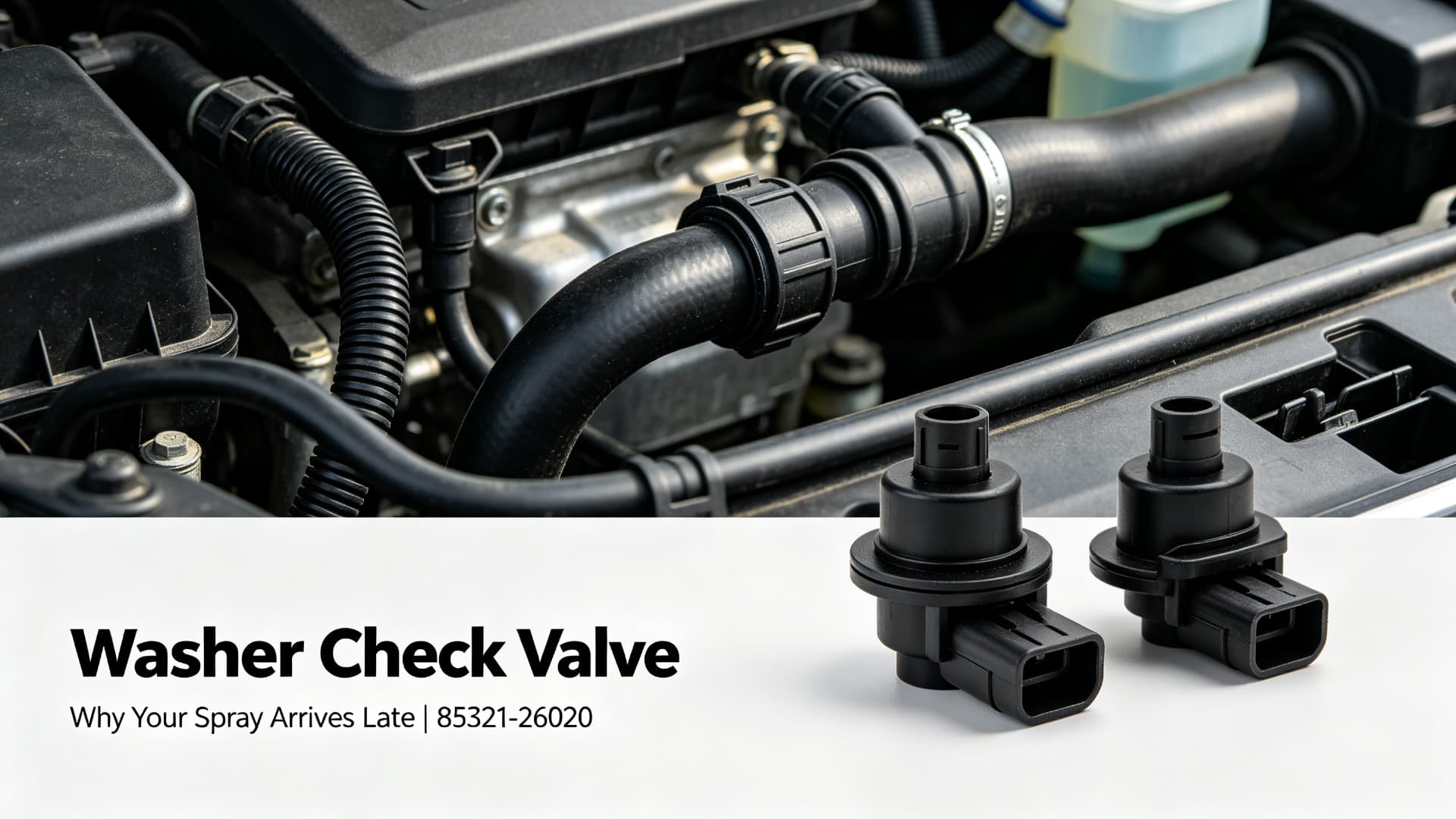
A washer check valve (also called a one-way valve) keeps fluid in the line so spray starts instantly instead of arriving after a delay.
Symptom of a failed check valve: you press the washer, nothing happens for a second, then fluid suddenly bursts out. Or the spray is weak and dribbles.
Check valves are cheap and usually sold separately from the nozzle. If you are already replacing a nozzle, inspecting the check valve at the same time saves a second repair. We stock Toyota/Lexus valves under 85321-26020 and 8532128020.
6. Heated nozzles and wiper-arm spray bars
Two nozzle types cause the most ordering confusion, so they are worth their own section.
Heated washer nozzles
Many vehicles sold in cold climates use heated nozzles — the housing contains a small heating element that keeps the orifice from freezing. You can usually tell by looking for a two-wire connector on the nozzle body in addition to the hose.
| Non-heated | Heated | |
|---|---|---|
| Connectors | Hose only | Hose + electrical plug |
| Price | Lower | Higher |
| Cold-weather behavior | Can ice over | Resists icing |
| Can you fit a non-heated part? | — | No — you will get a warning light or no spray in freezing conditions |
If your original nozzle has a wire, you must order a heated replacement. Ordering the cheaper non-heated version is a common and avoidable mistake.
Wiper-arm integrated spray bars
Some newer European models do not use a hood nozzle at all. Instead, a spray bar runs along the wiper arm and distributes fluid across the blade. If you cannot find a nozzle anywhere on the hood or cowl, check the wiper arm before ordering.
These assemblies are usually sold complete rather than as a separate insert, and they are model- and often chassis-specific.
Which one do I have?
| What you see | What it is | What to order |
|---|---|---|
| Small plastic jet on hood or cowl, hose only | Standard windshield nozzle | Match OEM number |
| Same, plus a wire connector | Heated nozzle | Heated OEM number |
| A bar or tube attached to the wiper arm | Spray bar assembly | Arm/chassis-specific part |
| Jet in the front bumper, aimed at the lamp | Headlight nozzle | Headlight-system part |
7. Hose, connectors and clips
Nozzles are rarely the only worn part. While you have the hood open, check:
- Washer hose — cracks and hardens with age, especially at the bends
- T and Y connectors — the plastic barbs snap easily
- Hood insulation clips and pads — often disturbed during the repair
- Reservoir cap — a cracked cap lets debris in, which is what clogs nozzles
Our universal washer hose kit includes 2 m of hose with T and Y connectors, which covers most single-vehicle jobs.
8. How to replace a washer nozzle (10 minutes)
- Open the hood and locate the nozzle — on the hood, the cowl below the windshield, or on the wiper arm.
- Release the retaining tab. Most nozzles have a spring clip underneath. Press it with a small flat screwdriver while lifting the nozzle.
- Disconnect the hose. Pull the hose off the nozzle barb. If it is stuck, twist gently — do not yank, or you will crack the hose.
- Check the old nozzle's number and confirm it matches what you ordered.
- Fit the new nozzle. Push the hose onto the barb until it seats, then clip the nozzle into the opening.
- Test the spray. Have someone operate the washer while you watch the pattern. Most nozzles have a small adjustment screw or can be nudged with a pin to correct the aim.
- Top up with the correct fluid. Do not use plain water — it scales and freezes.
Do not use compressed air to clear a nozzle while it is installed. It can blow the hose off its fitting inside the fender, which turns a 10-minute job into a bumper-removal job.
Frequently asked questions
How do I know which washer nozzle fits my car?
Find the OEM part number on your old nozzle, or look it up by year, make, and model. Match the number exactly. If you cannot find a number, use the fitment tables above and confirm the model and year range before ordering.
Are windshield washer nozzles universal?
No. Most are model-specific because the mounting tab, spray angle, and hose fitting differ. Universal nozzles exist and can work, but they usually need the aim adjusted and may not clip into the factory opening.
Can I replace just one nozzle?
Yes, and it is fine to do so. Nozzles fail independently. However, if both nozzles on your car are the same age, replacing them together saves a second job — and if you are paying for shipping, it is usually cheaper.
Why does my new washer nozzle spray over the roof?
The spray angle is wrong, which almost always means the part number does not match your model. Even visually similar nozzles have different internal angles. Confirm the number first; only then try adjusting the aim.
Why does spray only come out after a delay?
That is the classic symptom of a failed check valve, not the nozzle. The valve is a separate, inexpensive part. See section 5 above.
Can I clean a clogged nozzle instead of replacing it?
Sometimes. Remove the nozzle and soak it in warm water with a little vinegar, then clear the opening with a fine pin. If the plastic housing is cracked, the clip is broken, or the aim cannot be corrected, replace it. Hard water scale inside the housing usually cannot be fully removed.
Do you sell wholesale or bulk quantities?
Yes. We supply distributors, repair shops, online retailers, and private-label brands across the United States, Canada, and Mexico. See our wholesale and bulk orders page for pack quantities and pricing tiers.
What if my car is not in your tables?
Check the universal nozzles, or contact us with your OEM part number and we will tell you whether we stock it. We add fitments regularly based on customer requests.
Quick reference: the three mistakes that cause returns
- Ordering by "looks the same." Housing angle is invisible in a photo. Match the number.
- Confusing windshield and headlight nozzles. They are different systems with different mounting.
- Ignoring the check valve and hose. Half of "my new nozzle is weak" complaints are actually a failed valve or a cracked hose.
Related parts
- All windshield washer nozzles
- Windshield washer hose kit (universal 5 pcs)
- Honda Civic washer not working — 2006-2015 fix guide
- VW & Audi washer not working — Jetta/Golf/Passat/Tiguan/A3-Q7
- Wholesale & bulk orders
MotiveCrate supplies aftermarket auto wear parts — oil drain plugs, gaskets, windshield washer nozzles, trim clips and fasteners — for vehicles across the United States, Canada and Mexico. We do not sell safety-critical components such as braking, steering, suspension, airbag or seat-safety parts.
Need help matching a part?
Email service@motivecrate.com or message us on WhatsApp with your year, make, model and trim and we will confirm the part number for you.
MotiveCrate supplies aftermarket replacement parts and is not affiliated with any vehicle manufacturer. Fitment information is a compatibility guide — always verify the part number before ordering.